
SIMBox fraud is among the most expensive yet least visible threats operators face today. This sophisticated fraud scheme drains more than $5 billion from operators every year. It degrades service quality and exposes networks to regulatory and security risks, threatening both margins and reputation.
Traditional fraud detection systems aren’t equipped to stop this silent revenue drain, which undermines profit margins, customer trust, and regulatory compliance. Unlike major security breaches, SIMBox fraud operates covertly, making it harder to detect and more damaging over time.
Why SIMBox Fraud Is Escalating
The surge in global connectivity has created many new opportunities for fraudsters. The exponential growth of international calls, driven by remote work and digital expansion, has exposed more traffic to fraud than ever before. Remote work alone drove a 47% increase in international VoIP traffic in 2022, creating vast new attack surfaces for fraudsters to exploit.
Several factors are accelerating this threat:
Global Price Arbitrage
Countries with high call termination rates, especially in parts of Africa and Asia, remain prime targets for bypass fraud. Termination fees can be 10–20 times higher than local rates, offering fraudsters attractive profit margins.
Regulatory Gaps
In many markets, SIMs can still be bought anonymously or in bulk without proper identity checks. Weak registration processes, lack of biometric authentication, and no caps on SIM cards per subscriber enable fraudsters to stockpile SIM cards.
Technology Democratization
Falling prices of SIMBox hardware and software have made the fraud far more scalable and accessible. What once required costly, sophisticated equipment can now be deployed with cheap, readily available hardware, opening the doors to even small-time operators.
AI-Powered Evasion
Modern SIMBoxes use AI to mimic genuine user behavior patterns, making detection harder. They replace human calling patterns, switch operators to avoid detection algorithms, and even generate decoy traffic to confuse monitoring systems.
How SIMBox Fraud Works
SIMBox fraud exploits the price gap between local and international call termination through a simple but highly effective process. A SIMBox device, loaded with dozens or even hundreds of SIM cards, serves as the fraudster’s gateway for rerouting international calls as local ones. As a result, operators lose out on premium international interconnect fees they would have otherwise collected.
Here’s how the fraud unfolds: Fraudsters bulk-purchase SIM cards and insert them into SIMBox devices strategically located in target countries. When an international call is made, it is converted into VoIP traffic and rerouted through broadband to the SIMBox location. The system then manipulates the caller ID to display a local number, completing the call as local traffic.
The Cost of Inaction
Revenue Loss
Each bypassed international call creates direct revenue loss that compounds daily. A single SIMBox operation handling 1,000 concurrent calls can cost an operator $50,000-100,000 per month in lost termination revenues. Multiple fraud operations running in parallel can drive annual losses into eight figures.
Service Degradation
Fraudulent traffic overloads networks, resulting in lowering call quality and creating customer dissatisfaction. Rerouting international traffic through SIM boxes and substandard causes network congestion, call drops, and poor voice quality.
Regulatory Penalties
Failing to curb SIMBox activity can trigger serious regulatory consequences. Regulators are increasingly imposing fines and other penalties on operators that lack robust fraud controls.
Security Vulnerabilities
Bypassed calls evade lawful intercept systems, creating serious security risks and compliance violations. This blind spot can cause long-term brand damage and even loss of operating licenses.
Why Traditional Fraud Management Falls Short
Legacy fraud detection systems are ineffective against modern SIMBox operations. Call Detail Record (CDR) analysis offers broad network visibility but suffers from delays and high false positives. By the time suspicious patterns emerge in CDR data, fraudsters have already siphoned off significant revenue and often moved operations.
Test Call Generator (TCG) tools improve accuracy through active probing but offer narrow coverage and are increasingly evaded as fraudsters mimic legitimate traffic. TCGs cannot scan the whole network comprehensively, leaving behind blind spots that fraudsters exploit. Rule-Based Systems also struggle with sensitivity: too low, and fraud goes undetected; too high, and legitimate traffic gets blocked.
Modern fraudsters aggravate these challenges through IMEI spoofing, advanced evasion tactics, and honeypot decoys designed to confuse detection systems. They have industrialized fraud evasion, rendering conventional strategies obsolete.
How to Fight Back
Combating SIMBox fraud demands both advanced technology and operational excellence. Anomaly detection algorithms enable modern fraud defenses to learn baseline behavioral patterns of legitimate users and network traffic, spotting subtle deviations and complex fraud patterns.
Predictive analytics systems scan massive datasets to anticipate emerging fraud trends, while real-time monitoring processes vast data streams for immediate detection and response.
Behavioral analytics profile SIM usage patterns, user behavior, and device interactions to flag suspicious changes, while self-learning algorithms refine models continuously with new data and confirmed fraud patterns.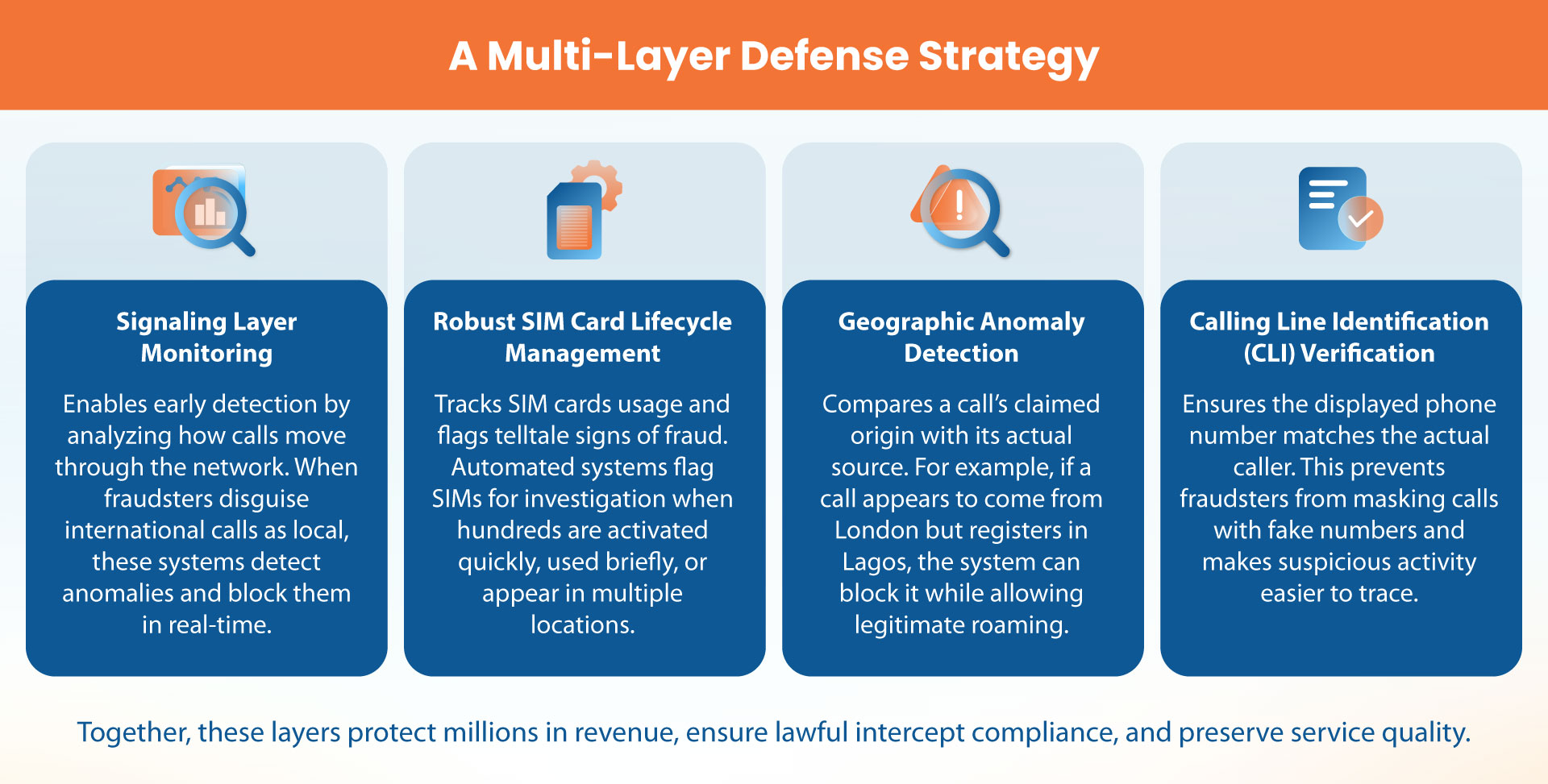
Operational Best Practices
Technology alone is not enough; organization readiness is equally critical. Break down silos between departments through cross-functional collaboration. Share insights and data across fraud management, network operations, IT, and billing for comprehensive threat visibility.
Regular audits and penetration testing reveal vulnerabilities before fraudsters exploit them, while continuous threat intelligence sharing through industry forums enables collective defense against emerging fraud patterns.
Most importantly, governance and executive ownership elevate fraud management from a technical concern to a board-level priority, ensuring adequate resources and organizational commitment to fraud prevention.
Future-Proofing Against SIMBox Fraud
The future belongs to operators who outpace fraud with intelligent, adaptive defenses that evolve faster than fraud itself. SIMBox fraud is a strategic revenue risk that demands a proactive response.
AI and automation have become essential to any fraud mitigation roadmap. Operators that delay investment risk becoming prime targets for increasingly sophisticated fraud operations.
The stakes are clear: operators must protect revenues, preserve customer trust, and maintain regulatory compliance through proactive, intelligent fraud defenses. The cost of inaction outweighs the investment in advanced fraud prevention.
Staying ahead of the fraudsters requires investing in agile and adaptive technologies. To explore how to future-proof your fraud defenses, connect with us.