
In today’s hyper-connected world, SMS remains one of the most ubiquitous yet vulnerable communication channels. While it plays a pivotal role in authentication, alerts, and enterprise messaging, it has also become a magnet for fraudsters exploiting every weak link in outdated telco infrastructure. Last year alone, 36% of mobile users were hit by frauds and threats like smishing, spam and scams. Beyond individual attacks, fraudsters use grey routes and SIM box fraud, causing financial losses in billions due to unbilled traffic. As fraud tactics grow more sophisticated, telecom operators must rethink their security posture—not just in terms of blocking threats, but in future-proofing their networks altogether. An answer to all of this is a powerful, proactive cloud-managed SMS firewall.
The Need for a Cloud-Managed SMS Firewall
A cloud-managed firewall is a centralized software-defined security layer sitting between the MNO and the subscriber traffic. This intelligent system seamlessly integrates with your existing infrastructure, including SMSCs, Diameter/SIGTRAN, and CPaaS platforms, ensuring comprehensive and always-on messaging security.
Core Benefits and Differentiators of a Cloud-Managed SMS firewall
Scaling to Adapt to the Explosive A2P Growth
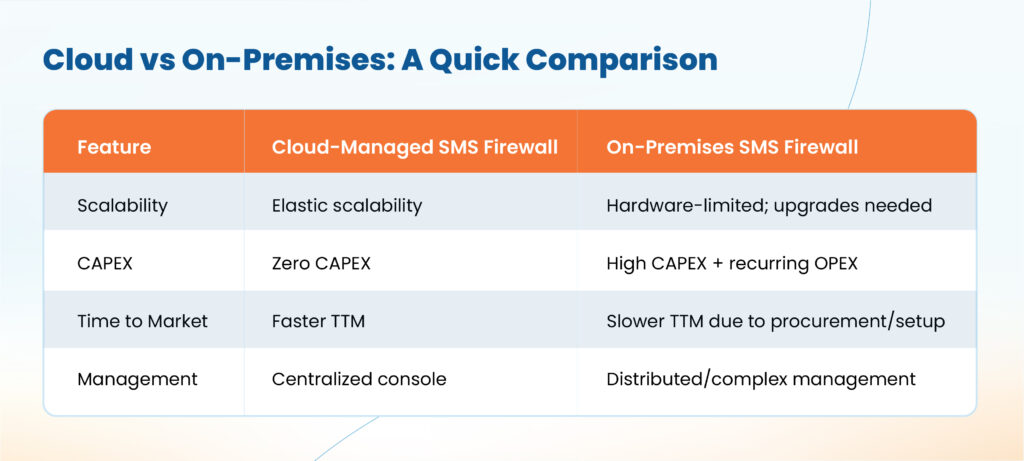
A2P SMS market is projected to surpass $92 billion by 2031 and operators need a flexible, scalable infrastructure to accommodate the rising traffic. A cloud-managed firewall can easily adapt to the traffic surge, thanks to its elastic scalability. This means operators can add or remove users or services in an inexpensive and non-disruptive way.
With an on-prem firewall setting, hardware limitations make it tougher and more expensive to scale and is also disruptive. The agility of cloud firewalls for SMS Security is crucial for avoiding costly over-provisioning or under-provisioning of resources, optimizing operational efficiency.
Always-On Protection
The world of telecommunications is always-on where MNOs cannot afford any disruptions or downtime which may lead to revenue loss and customer dissatisfaction. Cloud-managed SMS firewalls use virtualization and multi-site hosting, which ensures high uptime and immunity to localized outages. By maintaining redundant systems across multiple data centers, these firewalls offer a 24×7 resilient defense for your messaging and operational services.
Faster Time to Market (TTM)
Cloud-managed SMS firewalls are agile when it comes to TTM for new security measures. With their preconfigured set of rules, services can be deployed in days, which is a stark contrast to weeks or months required for an on-premises deployment. This rapid onboarding capability means MNOs can swiftly respond to emerging threats and regulatory requirements. Moreover, these upgrades and patches are applied instantly without service disruptions.
Proactive Security with AI
Modern SMS fraud is sophisticated and requires intelligent, proactive defense mechanisms. Cloud-managed firewalls can leverage the power of AI and ML to detect threats proactively. It’s significantly less expensive to deploy AI/ML engines within a cloud environment compared to an on-prem solution.
Cloud firewalls employ inline ML, which inspects and blocks malicious files instantly, and Zero-Delay Signatures, which deliver signature updates within seconds to stop new threats immediately. AI engines can flag subtle anomalies like sudden surges in international SMS traffic from previously dormant endpoints, which often indicate SIM box activation or spoofed campaigns. These pre-emptive alerts enable security teams to act before financial losses mount, making AI not just a feature, but a frontline defender in real-time.
Cloud platforms also enable multi-operator, multi-market management, providing a centralized and comprehensive view of the threat landscape across diverse operational environments for SMS Fraud Protection.
Staying Future-Ready
Investing in a cloud SMS firewall is an investment for your network’s future. Cloud-managed firewalls enable operators to offer secure messaging for vertical-specific SLAs through policy-based network slicing, enabling specialized and secure communication services. With predictive analytics, cloud firewalls can anticipate and pre-empt fraudulent activities, moving beyond reactive measures. Crucially, cloud firewalls can seamlessly embed into the Communication Platform as a Service (CPaaS) ecosystem, thus preparing networks for their growing demands for secure communication channels.
Enabling Compliance-First Security
Regulatory expectations in telecom are no longer optional; they are operational imperatives. From GDPR in Europe to TRAI in India and DPA in Africa, telecom operators are under pressure to implement traceable, policy-driven safeguards for messaging. Cloud-managed SMS firewalls offer built-in compliance features such as automated audit trails, real-time monitoring, and geo-fencing capabilities. These systems simplify regulatory reporting, reduce legal exposure, and demonstrate a proactive posture in customer data protection—critical in today’s privacy-conscious landscape.
Cloud-managed SMS firewalls enable a “compliance-first” security approach for telecom operators by offering global reach with multi-jurisdiction support, allowing adherence to diverse regulatory frameworks across regions. Their centralized management and auditing capabilities provide clear, comprehensive audit trails, simplifying compliance reporting and reducing manual effort.
Furthermore, continuous updates and patching ensure the security infrastructure remain aligned with evolving mandates. Critically, the inherent security and resilience of cloud environments, including robust disaster recovery capabilities, fulfill key regulatory requirements for service availability and data integrity, empowering operators to maintain a strong compliance posture while focusing on core business operations.
Addressing Read World Challenges in Cloud Deployment
Data Sovereignty and Regulatory Compliance
Cloud-managed SMS firewalls offer many advantages; however, Telcos need to consider the regulatory constraints specific to certain regions. Some countries like Africa and Asia require subscriber data to legally remain inside the national boundaries. This mandates that public cloud services hosted in external geographies, such as data centers in the UK or US, cannot be fully utilized.
To address these challenges, MNOs can explore these deploying models:
- A private cloud or hybrid solutions, where the firewall operates locally but its oversight is centralized.
- Hosting firewall instances directly within the country, while enabling group-level centralized reporting for multinational operator groups
- Ensure that any subscriber-identifiable data never departs from the country, even when performing monitoring or analytics
Connectivity and Throughput Constraints
The connectivity architecture needs operational consideration when managing high-volume P2P traffic. Unlike A2P traffic, which might be lower in volume but generates revenue, P2P traffic can amount to millions of messages daily. This often necessitates direct SCTP or SIGTRAN connections from the operator’s core network.
Attempting to route this substantial volume to a centralized cloud firewall and then back to the SMSC or switch introduces several issues. These include increased latency, strain on network bandwidth, and inherent architectural limitations.
To mitigate these concerns:
- Operators often deploy localized firewalls for real-time message filtering. They then utilize cloud resources for centralized monitoring, comprehensive analytics, and unified policy management.
- This hybrid approach effectively ensures optimal performance, maintains regulatory compliance, and allows for efficient handling of both A2P and high-volume P2P SMS flows.
Why Do Operators Need to Make the Shift Now?
The surge in A2P traffic, from authentication messages to notifications, demands a firewall that’s robust and scalable. Legacy firewall systems can’t keep up, and the industry preference agrees too, as 68% of new firewall installations amongst operators are expected to be cloud-based.
Beyond immediate market demands, the shift to cloud-managed SMS firewalls represent a strategic fit within the broader evolution of telecommunications networks. Telcos are actively moving from hardware to cloud-native layers. This shift makes cloud-based security solutions a natural and logical fit. Moreover, cloud firewalls offer better disaster recovery capabilities as data and configurations can be replicated automatically across geographically diverse servers. This ensures business continuity and zero-to-minimal disruption.
Finally, cloud-managed firewalls align seamlessly with the principles and future direction of 5G networks, Internet-of-Things (IoT) ecosystems, CPaaS models, and the broader Messaging-as-a-Service models. Adopting a cloud firewall is not just addressing the current threats but also reinforcing the network against future threats and beyond while supporting the next generation of services.
Conclusion
The evidence is clear: traditional, on-premises, reactive SMS firewalls are no longer viable. SMS frauds are evolving, and its relentless rise is costing operators millions of dollars. Operators need to upgrade to a cloud-managed SMS firewall with always-on messaging security to combat the evolving scale of SMS and threats.
Cloud firewalls’ inherent ability to adapt, scale and rapidly deploy services make it an indispensable tool for modern telecom operators. Telcos need to transition now to unlock operational simplicity and secure networks from current and future threats.
As telco networks evolve into digital service platforms, security must evolve too—from reactive response to predictive resilience. Cloud-managed SMS firewalls embody this shift, acting not just as shields but as enablers of trust, growth, and innovation. The operators who act now won’t just protect revenue—they’ll unlock it.
Connect with us to learn how our firewall solution can protect your telecom business in the ever-evolving landscape threats.